



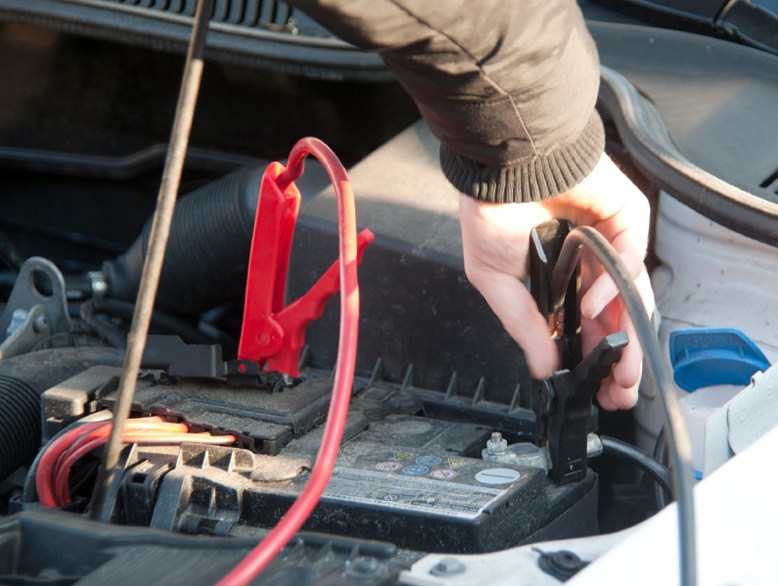
A dead battery can be a big hiccup in the day, but with a little know-how, you can minimize the inconvenience. Knowing how to safely jump-start your vehicle’s battery can get you back on the road with minimal down time. Jumping a car doesn't take many tools, though you will need to have jumper cables and someone willing to let you use their vehicle’s battery for the jump. Both owners involved should be comfortable opening their hoods and identifying their battery and battery terminals.
Jumper cables normally range from 10-20 feet long. While longer cables provide convenience, they may lose power because of the distance the energy has to travel. The gauge of a cable denotes the strength of the cable. A lower gauge means a thicker and stronger cable. The standard gauge for jumper cables is Gauge 6. A few safety tips to keep in mind before attempting to jump-start a vehicle are:
Be sure all small children are in safe area away from the engine
Check your vehicle’s manual in case of specialized steps for your vehicle
Be careful to prevent dangerous electric shocks
One the cables are connected to a car, do not touch the metal clamps to anything but the appropriate target
In case of flying sparks, protective glasses are recommended
Once you have considered all of the safety issues that you may have to contend with, it is time to prepare the vehicles for the jump-start. To set up for the jump:
Park functioning car so vehicles are facing one another
Set parking brake on both vehicles so that there are is no unexpected movement
Both cars should be turned off with keys removed
Set the jumper cables on the ground, making sure clamps do not touch each other
Open the hood of both cars, locate the batteries and battery terminals. You may need to check the manual for the location. Battery terminals are usually covered in red or black with a + or - sign on top. Look at the batteries to be sure you can identify which is positive and negative. If the terminals are dirty, wipe them with a rag or use wire brush if available.
Next, you will need to attach the cables:
Attach the positive (red) cable clamp to the positive battery terminal of the dead battery. Ensure a solid connection to the terminal, which may require some initial wiggling of the clamps.
Attach the positive (red) cable clamp on the other side of the jumper cable to the functioning vehicle’s positive battery terminal
Connect the negative (black) cable clamp to working battery’s negative battery terminal. Do not connect negative cable clamp to dead battery. Instead, attach that clamp to an unpainted, metal part of the car, such as a shiny, clean nut on the engine block. This will help ensure a safe jump.
Now that the vehicles are set up and connected, it is time to jump-start your car.
Start the working vehicle
Wait one minute or so. Depending on the age of the dead battery and how long since it died, you may need to let the car run for 1-2 minutes to get the jump to work
Try starting the dead car. If the vehicle doesn’t start, allow the working car’s battery to recharge for an additional minute or two before attempting again. In some instances, revving the engine of the working car slightly while charging the dead battery may help.
Once the dead car is running, you may disconnect the jumper cables, starting with the black, negative cable clamps. Don’t let the clamps touch each other while any part of the cables is still attached to the car.
Take a short drive, allowing the battery to build up a charge. Driving allows the vehicle’s alternator to charge the battery and ensures that your vehicle does not die once you turn it off
If the jump-start fails after several attempts or the dead vehicle starts for a while, but then dies again, there is another issue or issues that need to be addressed. Consider the battery’s age. Most batteries should last 4-6 years, so if the vehicle’s battery is older, it may be time to replace it. If the battery should be in good condition, other possible problems with other components include: fuses, battery corrosion, faulty alternator, ignition switch, or starter connection.
If you have trouble diagnosing the problem, the service team at Acura Carland would be happy to help you get back on the road as quickly as possible. Come by or give us a call at (770) 813-5812. Our service hours are Monday-Friday 7 AM- 7 PM, Saturdays 8 AM-6 PM.
For more information, find out more HERE.
